April marks one of the most important transitions in the Darwin solar calendar. The wet season is drawing to a close, the storms are easing, and the dry season — Darwin’s peak solar generation period — is about to begin. For any household that has invested in solar in Darwin, this seasonal shift is the single best opportunity of the year to ensure the system is clean, correctly calibrated, and ready to perform at its peak for the next seven months. A solar system that enters the dry season without a proper service is leaving money on the table every single day of that high-generation period. This guide explains why the April to May window is the optimal time for solar panel maintenance for Darwin homeowners should prioritise, and what a comprehensive dry-season service actually involves for homes across Darwin, Palmerston, Alice Springs, Katherine, and Tennant Creek.
What Happens to a Darwin Solar System During the Wet Season
Darwin’s wet season is the most demanding period in the year for any solar installation. Between October and April, systems are exposed to sustained high humidity, repeated lightning activity, heavy rainfall that deposits mineral-rich water on panel surfaces, biological growth on mounting hardware, and potential surge damage from electrical storms. By the time April arrives, even a well-maintained system has typically accumulated a layer of mineral crust and organic debris on the panels, possible corrosion on mounting hardware connections, and — in a significant proportion of cases — minor faults that developed quietly during wet season storm events. A thorough solar system service maintenance Darwin assessment at the start of the dry season identifies and resolves all of these issues before they cost the homeowner real money in lost generation.
| Wet Season Effect | Component Affected | Impact if Unaddressed | Dry Season Cost of Ignoring It |
| Mineral crust from evaporated rain | Panel surface | 10–20% output reduction | Lost generation across 7 months of peak sun |
| Biological growth on panels | Panel surface and frame | Permanent hot spot risk | Panel damage requiring replacement |
| Surge damage (minor) | Inverter, isolators, SPDs | Progressive fault development | Inverter failure at peak dry season output |
| Corrosion on mounting hardware | Rail clamps, roof penetrations | Structural weakening over time | Safety risk in next wet season |
| Battery BMS drift | Battery management system | Inaccurate SOC readings, reduced capacity | Reduced evening backup and savings |
Why April and May Are the Best Months for a Solar Service in Darwin
The timing of a dry-season solar service matters as much as the service itself. April and May offer a unique combination of conditions that make them the most productive months for seasonal solar maintenance NT professionals and homeowners alike. The wet season’s humidity has dropped sufficiently for electrical work and roof access to be safe and effective. The dry season’s dust accumulation has not yet begun in earnest, meaning a clean performed now will hold for longer before it needs repeating. And critically, any faults identified and repaired in April or May are resolved before the dry season’s peak generation period — giving homeowners the full benefit of June through October’s exceptional solar output.
There is also a practical scheduling advantage to booking in April or May. As the dry season progresses and more homeowners notice performance issues, the demand for service appointments increases. Booking early in the dry season means shorter wait times, more flexible scheduling, and the confidence of knowing your system has been assessed and optimised before peak generation season begins.
Important Read: Solar Panel Cleaning & Maintenance in Darwin: The Complete Guide to Maximizing Your System Efficiency
| Month | Why It’s Good for Servicing | Risk of Waiting | Generation Impact |
| April | Wet season ending; conditions safe for thorough inspection | Low — ideal timing | Captures full dry season generation |
| May | Full dry season begun; peak conditions for post-service verification | Low — still excellent timing | Captures most of dry season generation |
| June | Good conditions but some generation already lost | Medium — two months of peak output missed | Lost April–May generation unrecoverable |
| August | Mid dry season; booking demand high | High — five months of potential losses | Significant lost generation from unresolved faults |
| October (pre-wet) | Last chance before wet season stress returns | Very High — most of dry season lost | System enters next wet season without service |
What a Comprehensive Dry-Season Solar Service Includes
A professional dry-season solar system inspection in Darwin covers five key areas: panel cleaning and visual inspection, mounting system check, inverter and electrical assessment, battery system review (where applicable), and performance verification. Each area addresses specific wet-season wear and prepares the system for the dry season’s extended high-output period. The following breakdown gives Darwin homeowners a clear understanding of what they should expect from a thorough service appointment.
Panel Cleaning and Visual Inspection
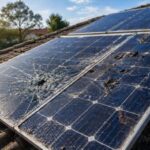
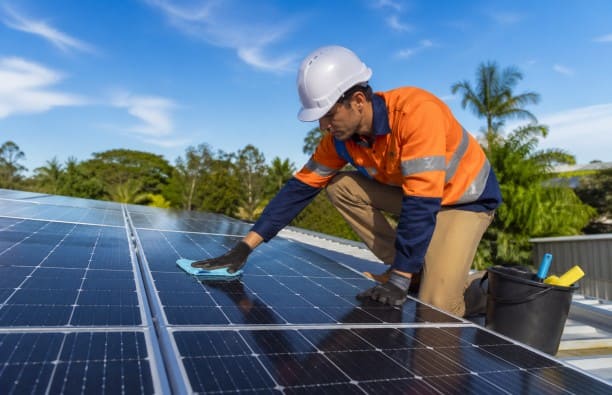
Professional panel cleaning at the start of the dry season removes the mineral crust, biological growth, and debris that have accumulated throughout the wet season. Unlike the light dust of the dry season, wet season deposits require deionised water and specific brush techniques to remove without scratching the anti-reflective coating. The cleaning visit also includes a visual inspection of each panel for micro-cracks, delamination, discolouration, and bird-dropping hotspot damage — conditions that are invisible from ground level but detectable during a professional close-range inspection.
Mounting System and Roof Penetration Check
Darwin’s wet season thermal cycling and wind loading can loosen mounting clamps and compromise roof penetration seals. A dry-season service includes checking all rail fasteners and clamps for correct torque, inspecting roof penetrations for seal integrity, and identifying any corrosion on mounting hardware that should be treated or replaced before it progresses. For systems installed more than five years ago, this structural check is particularly important, as cumulative thermal cycling over multiple wet seasons can gradually loosen hardware that appeared correctly tightened at installation.
Inverter and Electrical System Assessment
The inverter assessment covers surge protection device condition, DC isolator integrity, error log review, and a performance comparison against the system’s installation baseline. Surge protection devices that have absorbed lightning energy during the wet season may appear functional but have degraded protection capability — a risk that only becomes apparent when the next surge event occurs. Reviewing the inverter’s error log often reveals minor fault events during the wet season that the system self-cleared, but that indicate developing issues worth monitoring. This is the most technically important part of any solar servicing Darwin appointment, and the component most homeowners overlook when attempting DIY maintenance.
Important Read: Darwin Solar Panel Repair Specialists – Fast, Affordable, Trusted
| Service Component | What the Technician Does | Time Required | Estimated Cost |
| Professional panel clean | Deionised water clean, brush system, anti-reflective coating safe | 1–2 hours | $150–$300 |
| Panel visual inspection | Close-range check for micro-cracks, hotspots, delamination | 30–60 minutes | Included with clean |
| Mounting system check | Torque test all clamps; inspect seals and corrosion | 30–60 minutes | $100–$200 |
| Inverter and electrical check | Error log review, SPD condition, isolator test, performance baseline | 45–90 minutes | $150–$250 |
| Battery system review | BMS health, capacity check, backup mode test, firmware update | 30–60 minutes | $100–$200 |
| Performance verification | Post-service generation check against expected dry season baseline | 15–30 minutes | Included in service |
The Financial Return of a Dry-Season Solar Service
A complete dry-season service costs between $350 and $750, depending on system size and any remediation work required. That cost needs to be weighed against the generation value at risk from an unserviced system entering Darwin’s peak solar months. A 6.6kW system with panels producing at 85 per cent capacity due to wet season soiling and an inverter operating with a minor fault will lose approximately 15 to 20 per cent of its daily generation potential during the dry season — a loss of 4 to 7 kWh per day across seven months. At Darwin’s electricity rates of 29 to 35 cents per kilowatt-hour, that amounts to $250 to $540 in avoidable losses.
When the solar performance check Darwin identifies and resolves even a moderate fault, the service cost is fully recovered within weeks. For systems where an undetected wet season fault has caused progressive damage — such as a corroded DC connection or a partially failed surge protection device — the service prevents far more expensive component replacement later in the year.
| Service Outcome | Generation Recovered | Value at Darwin Tariffs | Service Cost Recovery Time |
| Panel clean only (soiling resolved) | 8–15% daily output improvement | $200–$420/year | Under 6 months |
| Minor fault resolved (inverter error) | Full system output restored | $400–$800/year (fault-dependent) | Under 3 months |
| SPD replaced before failure | Prevented inverter replacement | Saved $1,500–$3,000 repair | Immediate |
| Battery calibration corrected | Full battery capacity restored | $150–$400/year in evening savings | Under 6 months |
| Full service (all components) | System at peak dry-season performance | $600–$1,200 annual generation value | Under 4 months |
How to Book Your Dry-Season Solar Service with Oneroof Solar
Oneroof Solar schedules dry-season service appointments across Darwin, Palmerston, Alice Springs, Katherine, and Tennant Creek throughout April and May. Bookings in April are filling quickly as the end of the wet season brings a surge of service requests from NT homeowners who have noticed performance changes since the storms began. To secure your preferred appointment, contact Oneroof Solar this week with your system details — size, installation date, and any performance concerns you have noticed. The team will confirm an appointment and provide a detailed service report after every visit, giving you a complete record of your system’s condition and any work carried out.
Pricing Disclaimer: All cost figures are indicative estimates for the Northern Territory market as of April 2026, and may vary based on system size, property type, and installer rates. Contact Oneroof Solar for a precise quote tailored to your specific situation.
Frequently Asked Questions
Why is the start of the dry season the best time for a solar service in Darwin?
April and May offer the ideal combination of conditions for solar panel maintenance in Darwin: the wet season’s storm activity has ceased, humidity has dropped to safe levels for electrical work and roof access, and the dry season’s peak generation period is just beginning. Addressing any wet season damage or soiling now means the system operates at full capacity throughout June to October — Darwin’s best solar months.
How much does a dry-season solar service cost in Darwin?
A comprehensive dry-season service covering panel cleaning, mounting inspection, inverter assessment, and battery review typically costs between $350 and $750 for a standard residential system. This cost is almost always recovered within one dry season through improved generation and the prevention of more expensive repairs. Systems with identified faults may incur additional repair costs, but catching these issues early is consistently more cost-effective than allowing them to develop into component failures.
What happens if I skip the dry-season service?
A system that enters the dry season without a post-wet-season service will typically operate at 80 to 90 per cent of its potential capacity due to residual soiling and any minor unresolved wet-season faults. Over seven months of peak generation, this underperformance costs the average Darwin household $250 to $540 in lost electricity savings. Any unresolved electrical fault that progresses during the dry season can result in inverter failure or more extensive damage, converting a minor repair into a significant replacement cost.
Can I do my own dry-season solar service in Darwin?
Some parts of the service — specifically a gentle panel rinse and a visual inspection from ground level — can be done by the homeowner. However, the electrical components of a thorough service, including the inverter error log review, surge protection device testing, DC isolator check, and battery BMS assessment, require a licensed electrician with solar accreditation. Attempting these checks without the appropriate qualifications is both unsafe and potentially warranty-voiding.
How long does a professional solar service take in Darwin?
A comprehensive dry-season service for a standard 6.6kW system with a 13.5kWh battery typically takes three to four hours on-site, including panel cleaning, all inspection components, and the post-service performance verification. Larger systems or those requiring remediation work will take longer. Oneroof Solar provides a detailed service report on the same day, confirming all findings and any work completed.
Should I service my solar system even if it seems to be working normally?
Yes. Many of the most costly solar faults — surge-degraded protection devices, corroded DC connections, and minor panel hotspots — are not visible in monitoring app data until they have progressed significantly. A solar system inspection in Darwin by a qualified technician identifies these developing issues before they become expensive failures. A system that appears to be working normally can still be operating at 85 to 90 per cent of its potential due to soiling and minor faults that a service will resolve.
Does Oneroof Solar service solar systems in Alice Springs and the regional NT?
Yes. Oneroof Solar provides dry-season service appointments in Alice Springs, Katherine, Tennant Creek, and Palmerston, as well as Darwin. Regional appointments are scheduled on a territory-wide service run basis, with Alice Springs serviced from our dedicated Alice Springs office. Contact Oneroof Solar to confirm availability and scheduling for your location.
Verdict
April is not just a good time to service your Darwin solar system — it is the best time. The combination of wet season damage assessment, thorough cleaning, electrical verification, and battery review in April or May sets the system up for its most productive seven months of the year. For homeowners across Darwin, Palmerston, Alice Springs, Katherine, and Tennant Creek, the return on a dry-season service is among the highest of any solar investment made throughout the year. Contact the repairs and maintenance team at Oneroof Solar this week to secure your April or May service appointment before the peak booking period fills.
Get Your Free Solar Consultation
Contact Oneroof Solar for expert solar system servicing in Darwin:
Darwin Office Address: Level 1/48-50 Smith St, Darwin City NT 0800
Phone: 08 8004 7888
Hours: 8 am - 6 pm (7 days)
Alice Springs Office Address: 44 Zeil St, Araluen NT 0870
Phone: 04 8393 7004
Hours: 9 am - 6 pm (Sunday closed)
Website: oneroofsolar.com.au
Serving Darwin, Palmerston, Alice Springs, Katherine, and Tennant Creek with quality solar installation services.
About the Author
This article is brought to you by the expert team at Oneroof Solar, the Northern Territory’s most trusted local solar installers and service providers. With over 200 successful installations across Darwin, Palmerston, Alice Springs, Katherine, and Tennant Creek, we are passionate about helping Territory families and businesses achieve complete energy independence through quality solar and storage solutions designed for the NT’s unique climate.