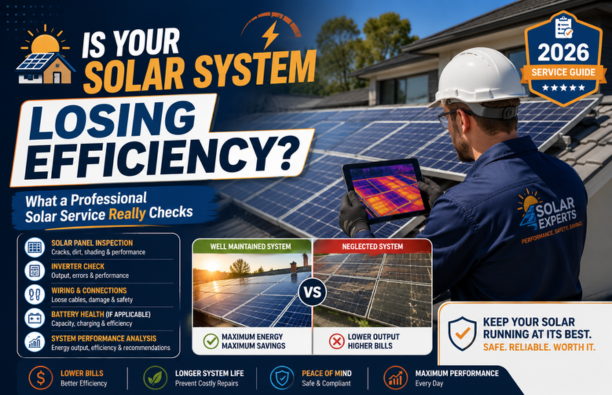
If you have never had your Darwin solar system professionally serviced, you might wonder what a technician actually does during a service visit that justifies the cost. The honest answer is more than most homeowners expect — and more than any homeowner can replicate themselves without specialist equipment and electrical qualifications. A well-executed solar system service maintenance Darwin visit is not a routine inspection that confirms everything looks fine. It is a diagnostic process that identifies developing faults, quantifies performance losses, and produces findings that change what the homeowner does next. This guide explains exactly what a professional service covers, what each check actually tests for, and what the findings typically cost to resolve versus what they cost if they are left unaddressed in Darwin’s demanding conditions.
Why “Looking Fine” Is Not the Same as Performing Well
The most common misconception about solar maintenance in Darwin is that a system that appears to be working normally is therefore performing at its best. In reality, a solar system can lose 15 to 25 per cent of its generation capacity to a combination of soiling, minor electrical faults, and heat-related degradation without triggering any error codes or visible indication of a problem. The monitoring app shows generation — but it shows actual generation, not potential generation. The gap between what your system is producing and what it should be producing is invisible unless someone measures it. That measurement is the core purpose of a professional service.
The Six Areas a Thorough Service Covers
Area 1: Panel Cleaning and Visual Inspection
The service begins on the roof. A qualified technician accesses each panel to carry out two tasks simultaneously: a professional deionised water clean that removes the mineral crust, dust, and biological growth that reduces output, and a close-range visual inspection of each panel’s surface, frame, and rear junction box. This inspection checks for micro-cracks in the cell glass, delamination of the encapsulant layer, discolouration that indicates hotspot damage, and any physical frame damage that could compromise weatherproofing. These conditions are invisible from ground level but detectable from 30 centimetres away by a trained eye. For Darwin systems, the junction box seal condition is particularly important, as humidity infiltration during the wet season can cause progressive corrosion of internal connections that eventually cause a panel to fail entirely.
Area 2: Mounting System and Roof Penetration Check
The mounting system holds your panels against Darwin’s cyclone winds. Over time, thermal cycling — the daily expansion and contraction of metal components through a 20 to 60-degree temperature range — gradually loosens clamps and fasteners that were correctly torqued at installation. A service includes torque testing every clamp and rail fastener to confirm it remains within the manufacturer’s specification. Roof penetration seals are inspected for cracking or lifting that could allow water ingress, particularly relevant after Darwin’s wet season. Any corrosion on mounting hardware is identified and treated or scheduled for replacement before it weakens the structural integrity of the array.
Area 3: Inverter Diagnostic and Error Log Review
The inverter assessment is the most technically important part of any solar panel maintenance Darwin visit and the component that most clearly requires specialist equipment. The technician connects to the inverter’s internal diagnostics port or web interface to download the error log — a complete record of every fault event the inverter has experienced, including those that self-cleared without appearing on the display. In Darwin, this log typically reveals one to three minor surge events per wet season that the inverter absorbed and self-cleared, each of which contributes to the cumulative degradation of the inverter’s surge protection devices. The technician also checks the inverter’s operating temperature profile, AC and DC voltage readings, and the condition of all visible internal connections.
Area 4: Surge Protection Device Testing
Surge protection devices (SPDs) are the front line of defence against Darwin’s 80-plus annual lightning days. They work by absorbing voltage spikes before they reach the inverter — but each absorption event degrades their protection capacity. Unlike most solar components, SPDs do not fail visibly. A depleted SPD looks identical to a fully functional one. The only way to know whether your SPDs retain adequate protection capacity is to test them with a dedicated testing device. A professional service includes this test, and SPDs that have fallen below the required protection threshold are replaced. This single check prevents the most common cause of inverter replacement in Darwin.
Area 5: DC Wiring and Connection Integrity
The DC wiring that connects your panels to the inverter operates at voltages of up to 600 volts in most residential systems. Over time, UV exposure, thermal cycling, and humidity cause insulation to harden and crack, and MC4 connector seals to degrade. A professional solar system inspection in Darwin includes an insulation resistance test (IR test) of the DC wiring, which measures whether the insulation is maintaining adequate electrical separation. A degraded result on an IR test indicates insulation breakdown that, if left unaddressed, will eventually cause a DC arc fault — a fire risk. The check also includes a visual inspection of all accessible MC4 connectors and conduit runs for physical damage or signs of moisture ingress.
Area 6: Battery System Health Assessment
For systems with a battery installed, the service includes a State of Health (SOH) check, a battery management system (BMS) diagnostic, a backup mode test, and a firmware update if one is available from the manufacturer. The SOH reading expresses the battery’s current usable capacity as a percentage of its original rated capacity — a figure that declines over time and with charge cycles. A healthy battery in Darwin should retain above 90 per cent SOH after two years of operation. A reading below 80 per cent in a system less than five years old warrants investigation and may indicate a warranty claim or a siting issue causing accelerated degradation.
Important Read: Solar in Darwin: The Complete 2026 Guide for NT Homeowners
| Service Area | What the Technician Checks | Equipment Required | Darwin Priority Level |
| Panel clean and visual inspection | Surface soiling, micro-cracks, delamination, hotspot damage, junction box seals | Deionised water system, close-range inspection | Critical — wet season deposits |
| Mounting system torque test | Clamp torque, rail fastener integrity, roof penetration seals, corrosion | Torque wrench, inspection tools | High — cyclone zone compliance |
| Inverter diagnostic and error log | Error history, operating temperature, voltage readings, connection condition | Laptop with inverter software, multimeter | Critical — surge event review |
| SPD testing | Remaining protection capacity of DC and AC surge protection devices | SPD tester | Critical — Darwin lightning risk |
| DC wiring IR test | Insulation resistance of DC wiring, MC4 connector condition | Insulation resistance tester | High — UV and humidity degradation |
| Battery SOH check | State of health, BMS diagnostic, backup mode test, firmware status | Battery management software | High (if battery installed) |
What the Service Findings Typically Cost to Fix — and What They Cost to Ignore
The value of a professional solar servicing Darwin visit is best understood through the lens of what each finding costs to resolve when caught early versus what it costs when it is left unaddressed. The following figures are drawn from Oneroof Solar’s NT service data and reflect typical outcomes for Darwin systems across a range of ages and conditions.
| Finding | Repair Cost if Caught at Service | Cost if Left Unaddressed | Typical Frequency in Darwin Systems |
| SPD replacement (depleted) | $200–$400 | $1,500–$3,000 inverter replacement from surge damage | 1 in 3 Darwin systems after 3+ wet seasons |
| Panel clean (moderate soiling) | $150–$300 | $400–$900/year in lost generation value | Almost universal after each wet season |
| Loose mounting clamp (torque issue) | $50–$150 (included in service) | Panel displacement in cyclone; safety and insurance risk | 1 in 5 systems after 4+ years |
| DC wiring IR test failure | $300–$800 (wiring repair) | DC arc fault; fire risk; inverter damage | Rare but critical when found |
| Battery SOH below 80% | $0 (warranty claim pathway) | Continued capacity loss; replacement cost $4,000–$12,000 outside warranty | Depends on siting and brand |
| Minor inverter error log events | $0 (monitoring note) | Progressive SPD depletion leading to inverter failure | Very common — 3–7 events per wet season |
Is a Professional Service Worth the Cost?
A comprehensive solar system service maintenance Darwin visit costs between $350 and $750 for a standard residential system, depending on size and any remediation work identified. The question of whether this cost is worth it can be answered by a single example: a service that identifies and replaces two depleted SPDs ($300 in parts) prevents a surge-damaged inverter ($2,000 to $3,000 replacement). The service pays for itself several times over from that single finding alone, independent of the generation value recovered from the panel clean or the peace of mind from confirming the mounting system’s cyclone compliance. For Darwin homeowners, the question is not really whether a service is worth it. The question is whether the cost of not having one is worth it instead.
| Service Scenario | Service Cost | Savings Delivered | Net Position |
| Clean only (no faults found) | $350–$500 | $400–$900 generation value restored per year | Positive ROI within 6 months |
| Clean + SPD replacement | $500–$700 | $2,000–$3,000 inverter replacement prevented | Positive ROI immediately |
| Clean + mounting repair | $500–$750 | Cyclone damage risk eliminated; insurance claim avoided | Positive ROI (risk value) |
| Full service, no issues found | $350–$600 | Confirmed system health; generation optimised | Value in generation + assurance |
| No service for 3+ years | $0 spent | Cumulative losses of $1,500–$4,000+ | Negative — false economy |
Important Read: Solar Panel Cleaning & Maintenance in Darwin: The Complete Guide to Maximizing Your System Efficiency
Frequently Asked Questions
How often should a Darwin solar system be professionally serviced?
Most solar panel maintenance Darwin specialists recommend an annual service, ideally timed at the end of the wet season (April to May) when storm-related wear can be assessed before the dry season’s peak generation period begins. Older systems (more than five years), systems in high lightning exposure areas, or systems where SPD replacement has not been confirmed recently may benefit from twice-yearly servicing. A minimum of one professional service per year is the industry standard for NT conditions.
Can I do any of these checks myself?
Homeowners can safely carry out a ground-level visual inspection, a monitoring app generation check, and a gentle panel rinse. These DIY checks are valuable for identifying obvious issues between professional services. However, the SPD test, IR wiring test, inverter error log download, and battery SOH check all require specialist equipment and, in the case of electrical testing, an appropriate electrical licence. Attempting these checks without the correct qualifications is both unsafe and potentially warranty-voiding for the components involved.
What does a Darwin solar service cost?
A comprehensive solar system inspection in Darwin covering all six areas described in this guide costs $350 to $750 for a standard 6.6 to 13kW residential system, depending on size and any remediation work required. Panel cleaning is often included or available as an add-on. Oneroof Solar provides a detailed written report after every service visit, documenting all findings and any work completed.
What is the most commonly found issue during Darwin solar services?
Depleted surge protection devices are the most frequently identified finding in Darwin service visits, present in approximately one in three systems that have been through three or more wet seasons without an SPD check. Panel soiling from wet season mineral deposits is nearly universal after any wet season. Loose mounting clamps from thermal cycling appear in approximately one in five systems more than four years old. Finding these issues at service is consistently less expensive than discovering them after they have caused further damage.
Does servicing my solar system affect the manufacturer's warranty?
Professional servicing by a CEC-accredited technician does not void manufacturer warranties and, in many cases, is required by warranty terms to maintain coverage. Evidence of regular servicing strengthens rather than weakens a warranty claim, demonstrating that the system was maintained as required. DIY electrical work, by contrast, voids most manufacturer warranties. Always use an accredited professional for any electrical component of your service.
How do I know if my SPDs need replacing without a service?
You cannot reliably determine whether your SPDs are depleted without specialist testing equipment. SPDs do not change in appearance when their protection capacity degrades, and they do not trigger inverter error codes when they fail. The only reliable method of confirmation is an SPD test during a professional service visit. This is precisely why regular servicing matters in Darwin — the most important protection device in your system is invisible to DIY assessment.
Does Oneroof Solar service all NT locations?
Yes. Oneroof Solar’s service team covers Darwin, Palmerston, Alice Springs, Katherine, and Tennant Creek. Regional service appointments are scheduled on a territory-wide run basis and coordinated from our Darwin and Alice Springs offices. Contact us to confirm scheduling availability for your specific location.
Verdict
A professional solar service is not a luxury for conscientious owners — it is the mechanism by which Darwin’s most common and most expensive solar faults are caught before they become irreversible. The six areas covered in a thorough service — panel cleaning, mounting integrity, inverter diagnostics, SPD testing, DC wiring IR testing, and battery SOH assessment — address every significant source of performance loss and component risk in an NT solar system. For homeowners across Darwin, Palmerston, Alice Springs, Katherine, and Tennant Creek, booking an annual solar system service maintenance Darwin visit is the single most cost-effective maintenance decision available. Contact Oneroof Solar today to schedule your May service before the dry season’s peak generation period begins.
Pricing Disclaimer: All cost and savings figures referenced in this blog are indicative estimates for the Northern Territory market as of May 2026 and may vary based on system size, property type, and installer rates. Contact Oneroof Solar for a precise quote tailored to your specific situation.
Get Your Free Solar Consultation
Contact Oneroof Solar for expert solar system servicing in Darwin:
Darwin Office Address: Level 1/48-50 Smith St, Darwin City NT 0800
Phone: 08 8004 7888
Hours: 8 am - 6 pm (7 days)
Alice Springs Office Address: 44 Zeil St, Araluen NT 0870
Phone: 04 8393 7004
Hours: 9 am - 6 pm (Sunday closed)
Website: oneroofsolar.com.au
Serving Darwin, Palmerston, Alice Springs, Katherine, and Tennant Creek with quality solar installation services.
About the Author
This article is brought to you by the expert team at Oneroof Solar, the Northern Territory’s most trusted local solar installers and service providers. With over 200 successful installations across Darwin, Palmerston, Alice Springs, Katherine, and Tennant Creek, we are passionate about helping Territory families and businesses achieve complete energy independence through quality solar and storage solutions designed for the NT’s unique climate.