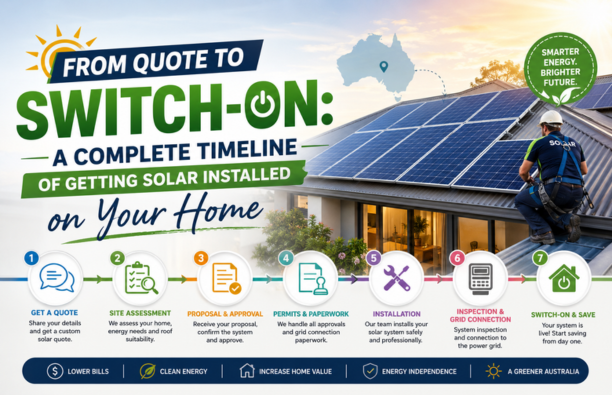
Most Darwin homeowners who go solar say the same thing afterwards: it was easier than they expected, but they wish someone had told them what to expect before they started. The process of going from “I’m thinking about solar” to a fully operational system generating free electricity has a defined sequence of stages, each with its own timeline and its own set of decisions. Understanding that sequence before you begin puts you in control of the process rather than waiting to be told what happens next. This guide walks through the complete journey of a solar installation in Darwin — from your first enquiry call through to the moment your system switches on and starts reducing your electricity bill. Every stage, every decision point, and every waiting period is explained so there are no surprises.
The Full Timeline at a Glance
A typical Darwin solar installation runs from two to five weeks end-to-end, depending on product availability, installer scheduling, and network provider processing times. The following overview maps out the key stages and their expected durations. The actual timeline for your installation may vary, particularly during high-demand periods such as the April and May rebate-deadline rush.
| Stage | What Happens | Who Is Responsible | Typical Duration |
| 1. Initial enquiry | You contact Oneroof Solar; consultant collects basic household info | You + Oneroof Solar | Same day |
| 2. Site assessment | Technician reviews roof, consumption, and shading profile | Oneroof Solar technician | 1–2 business days |
| 3. Itemised quote | Full system quote with brand, model, and price detail provided | Oneroof Solar | Within 24–48 hours of assessment |
| 4. Quote acceptance and deposit | You approve the quote and pay deposit to confirm your booking | You | Your decision timeline |
| 5. Equipment ordering | Panels, inverter, battery, and mounting hardware ordered and scheduled | Oneroof Solar | 3–5 business days (NT-stocked items faster) |
| 6. Installation day | Full system installed on-site by accredited crew | Oneroof Solar installation crew | 1–2 days on-site |
| 7. Grid connection application | Application submitted to Power and Water Corporation | Oneroof Solar (on your behalf) | Submitted same day as installation |
| 8. Network approval and meter config | Power and Water Corporation processes connection and configures meter | Power and Water Corporation | 5–10 business days |
| 9. System energisation | Final sign-off; system switched on; monitoring app connected | Oneroof Solar + you | Within 1 business day of network approval |
Stage 1 and 2: The Conversation and the Site Assessment
The starting point for any good solar installation is not a price — it is a conversation. When you contact one of the reputable solar companies in Darwin, the first call should cover your recent electricity bills, your typical usage patterns, whether you are interested in battery storage, and any roof constraints you are aware of. This information shapes the site assessment that follows.
The site assessment is where the real system design begins. A qualified technician visits your property to assess roof orientation and pitch, available panel space, shading from trees or structures, the location and condition of your switchboard, and the best placement for the inverter. For Darwin properties, this visit also confirms that the proposed mounting system design meets Australian Standard AS 1170.2 Region D — the cyclone-zone wind load requirement that applies across the NT. Do not accept a quote from any company that has not physically assessed your roof or, at minimum, completed a detailed remote assessment using satellite imagery and a follow-up call to confirm the findings.
| What a Good Site Assessment Covers | Why It Matters | Darwin-Specific Factor |
| Roof orientation and tilt angle | Determines daily generation profile and annual output estimate | North-facing preferred; east/west split common in Palmerston homes |
| Available panel area (m²) | Sets the upper limit on system size regardless of consumption needs | Older Darwin hip roofs often have less north-facing space than expected |
| Shading analysis | Identifies trees, structures, or chimneys that reduce panel output | Wet season tree growth can shade panels that were clear at install time |
| Switchboard condition and capacity | Old switchboards may need upgrading to accommodate solar | Pre-2000 Darwin homes frequently need switchboard work |
| Inverter location | Inverter must be shaded, ventilated, and accessible for service | Direct sun on inverter causes derating in Darwin’s heat |
Stage 3 and 4: The Quote and Your Decision
A properly prepared solar quote is a document, not a phone call figure. It should list every component by brand and model number, including the panel (brand, model, wattage, quantity), the inverter (brand, model, capacity), the battery if included (brand, model, capacity), the mounting system specification, all electrical work and compliance testing, the warranty terms for each component, and the projected annual generation and bill savings based on your specific assessment. If any of these elements are missing, the quote is incomplete.
Once you receive your quote, you are under no obligation to decide on the day. Reputable solar power Darwin companies do not use high-pressure same-day tactics. Take the time to compare quotes from two or three CEC-accredited installers, ensure you are comparing equivalent system specifications, and check that each installer has demonstrated NT experience. When you are ready to proceed, a deposit confirms your installation date and triggers equipment ordering. Most installers require a deposit of 20 to 30 per cent of the total system cost at this stage.
Stage 5 and 6: Equipment and Installation Day
Once your deposit is received, the installer orders the equipment specified in your quote. For Oneroof Solar’s Darwin installations, most solar panel installation Darwin components are held locally in Darwin, which significantly reduces lead times compared to interstate suppliers. Equipment delivery to regional NT locations, including Katherine, Tennant Creek, and beyond Alice Springs, requires additional logistics time that your installer should account for in the scheduling.
Installation day is typically the most straightforward part of the process from the homeowner’s perspective. For a standard 6.6 to 10kW residential system, the crew will arrive in the morning, complete the roof mounting and panel installation, run DC wiring to the inverter, complete the AC connection and switchboard work, and commission the system — all in a single day. Larger systems or those with complex roof designs may require two days. You do not need to be home for the full installation, but it is useful to be available at the start and end of the day for a brief walk-through.
| Installation Day Sequence | What Happens | Approximate Time |
| Morning start | Crew arrives; safety check; scaffolding or roof access set up | 7:00–8:00 am |
| Roof mounting | Rails installed, panels mounted and secured to AS 1170.2 spec | 8:00 am–12:00 pm |
| DC wiring and inverter connection | DC wiring run from panels to inverter; inverter installed and connected | 12:00–2:00 pm |
| AC and switchboard work | AC connection made; solar circuit added to switchboard; compliance test | 2:00–3:30 pm |
| System commissioning | Inverter powered on; generation confirmed; monitoring app configured | 3:30–4:30 pm |
| Handover and documentation | Walk-through with homeowner; warranty docs and monitoring access provided | 4:30–5:00 pm |
Stage 7 to 9: Grid Connection and Switch-On
The final stage — grid connection — is the one that most Darwin homeowners find unexpectedly involves a waiting period. After installation is complete, your installer submits a grid connection application to Power and Water Corporation on your behalf. The network provider must review and approve the connection, update your meter configuration to enable the feed-in tariff, and confirm the system is safe to energise. This process typically takes five to ten business days, though during peak periods it can extend to two weeks.
During this waiting period, your panels are physically installed, but the system is not yet switched on. Once Power and Water Corporation grants approval, your installer completes the final energisation, connects your monitoring app, and hands you a fully operational solar energy Darwin system. From that point, your solar generation begins and your electricity bill starts reflecting the savings. Most Darwin homeowners see their first meaningfully reduced electricity bill within four to six weeks of their system switching on.
| Common Cause of Delay | Stage Affected | How Long It Adds | How to Avoid or Manage It |
| Switchboard upgrade required | Between quote and installation | 1–2 weeks for electrician | Identified at site assessment; schedule concurrently |
| Equipment not in local stock | Equipment ordering | 1–3 weeks | Choose installer with NT local stock |
| Peak booking demand (April/May) | Installation scheduling | 1–3 weeks extra wait | Book early in the season |
| Power and Water processing backlog | Grid connection | Up to 3 weeks in busy periods | Accept that this stage is outside installer control |
| Additional roof work needed | Installation day | 1–2 extra days | Flag potential roof issues in initial assessment |
What Good Communication Looks Like Throughout the Process
A reliable installer keeps you informed at every stage without you having to chase for updates. You should receive confirmation of your booking date within 24 hours of your deposit, a notification when your equipment arrives, a confirmed installation date at least one week in advance, an update when your grid connection application is submitted, and a notification the moment your approval is received and your system is ready to switch on. If you find yourself regularly having to call to find out what is happening, that is a signal worth noting.
| Stage | Communication You Should Receive | If You Do Not Receive It |
| After deposit | Booking confirmation and equipment ETA within 24 hours | Call the installer — this is a basic expectation |
| Before installation | Installation date confirmed at least 5–7 business days prior | Request confirmation in writing |
| After installation | Grid connection application reference number same day | Ask for reference number before crew leaves |
| During grid connection wait | Proactive update if delays arise beyond 10 business days | Contact Power and Water directly using your application reference |
| At energisation | Monitoring app activation and first-week check-in call | Contact installer to confirm monitoring is live |
Frequently Asked Questions
How long does it take to get solar installed in Darwin?
From initial enquiry to a switched-on system, the typical Darwin timeline is two to five weeks. Installation day itself takes one to two days for most residential systems. The main variable is the grid connection approval from Power and Water Corporation, which takes five to ten business days in normal periods. During high-demand periods such as the May rebate deadline rush, both installer scheduling and network processing times can extend the total timeline by one to two weeks.
Do I need to be home on installation day?
You do not need to be present for the entire installation day, but it is helpful to be available at the start for a brief site walk-through with the crew leader and at the end for the handover and system commissioning. If you cannot be there in person, ensure a responsible adult is available to grant access and that you are reachable by phone. The crew will need access to your switchboard, roof, and the planned inverter location throughout the day.
What happens between installation day and the system switching on?
After installation, your panels and inverter are physically in place, but the system is not yet energised. Your installer submits a grid connection application to Power and Water Corporation, which reviews the application, updates the meter configuration for feed-in tariff purposes, and grants approval. This administrative process takes five to ten business days. Once approval is received, your installer completes a brief final energisation visit, and your solar system in Darwin, NT, goes live.
Can I speed up the grid connection process?
The grid connection approval is processed by Power and Water Corporation and is outside your installer’s control once the application is submitted. The best way to avoid delays is to ensure your switchboard is in good condition before installation (identified at the site assessment), that the installation is completed without any compliance issues requiring follow-up, and that your installer submits the application correctly on the day of installation. Beyond that, the processing timeline is determined by Power and Water’s current workload.
What finance options are available, and do they affect the timeline?
Oneroof Solar offers a zero-interest payment plan and a green loan, both of which can be approved quickly enough to allow April and May installations without delaying the booking. Finance applications can typically be assessed within one to two business days. The NT Battery Grant Scheme rebate is applied at installation as a direct discount, so eligible homeowners do not need to pay the grant amount upfront and claim it back.
What documents do I receive after installation?
After installation and energisation, you should receive a certificate of electrical compliance (from the licensed electrician), all manufacturer warranty documentation for panels, inverter, and battery, your monitoring app login details and a brief guide on how to use it, the grid connection approval confirmation from Power and Water Corporation, and documentation confirming your feed-in tariff registration. Keep all of these documents safely — they are needed for any future warranty claims or insurance claims relating to the system.
What is the first thing I should check after my system switches on?
The day after your system switches on, open your monitoring app and check the previous day’s generation figure. Compare it against the expected daily output your installer provided in the quote. A clear, sunny Darwin day with a 10kW system should show 50 to 65 kWh of generation. If the figure is significantly below expectations on a clear day, contact your installer immediately — most early-stage issues are minor commissioning matters that are straightforward to resolve but are easier to diagnose in the first week than after months of operation.
Verdict
The solar installation process in Darwin is more streamlined than most homeowners expect, and understanding each stage before you start means you can participate in the process rather than just wait for it to happen. The stages that matter most — the site assessment, the itemised quote, and the handover documents — are also the ones that most clearly distinguish a professional solar company in Darwin from one that is cutting corners. Oneroof Solar manages every stage of the installation process for customers across Darwin, Palmerston, Alice Springs, Katherine, and Tennant Creek — from first enquiry to monitoring app activation. Contact us today, and we will walk you through exactly what to expect for your specific property.
Pricing Disclaimer: All cost and savings figures referenced in this blog are indicative estimates for the Northern Territory market as of May 2026 and may vary based on system size, property type, and installer rates. Contact Oneroof Solar for a precise quote tailored to your specific situation.
Get Your Free Solar Consultation
Contact Oneroof Solar for expert solar installation in Darwin:
Darwin Office Address: Level 1/48-50 Smith St, Darwin City NT 0800
Phone: 08 8004 7888
Hours: 8 am - 6 pm (7 days)
Alice Springs Office Address: 44 Zeil St, Araluen NT 0870
Phone: 04 8393 7004
Hours: 9 am - 6 pm (Sunday closed)
Website: oneroofsolar.com.au
Serving Darwin, Palmerston, Alice Springs, Katherine, and Tennant Creek with quality solar installation services.
About the Author
This article is brought to you by the expert team at Oneroof Solar, the Northern Territory’s most trusted local solar installers and service providers. With over 200 successful installations across Darwin, Palmerston, Alice Springs, Katherine, and Tennant Creek, we are passionate about helping Territory families and businesses achieve complete energy independence through quality solar and storage solutions designed for the NT’s unique climate.